What you’ll learn in this chapter:

By the end of this chapter, you’ll be able to:

  • Understand the benefits of adding short band-based routines into daily life.
  • Learn evidence-based reasons why short daily band movements dramatically improve health and performance.
  • Master practical teaching tips to deliver effective, time-efficient stretch sessions for all ability levels.

Why short Daily Routines matter:

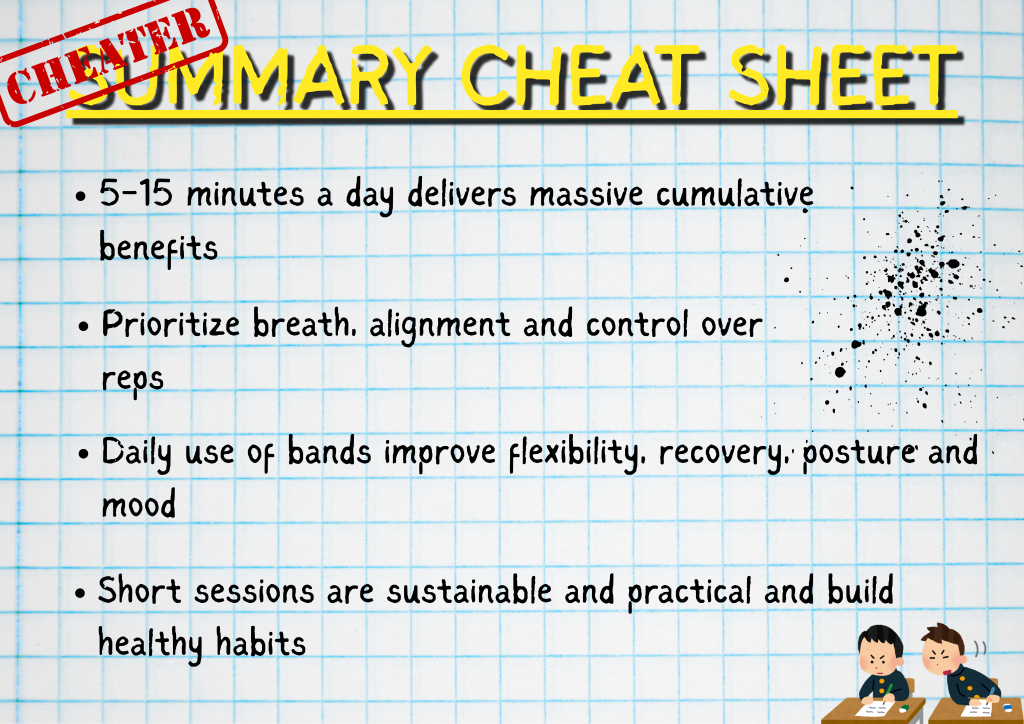
Even 5-15 minutes of daily band work can have profound benefits:
Let the band support the stretch, allowing the body to relax and release into it.

Why it’s useful:

  • Improved flexibility and range of motion
  • Daily gentle resistance stretching helps maintain and progressively improve flexibility without requiring long sessions (Behm et al. 2016)
  • Joint health and longevityDaily dynamic stretching improves synovial fluid, lubricating joints and reduces stiffness (Page P, 2012)
  • Reduces muscle stiffness and sorenessBands allow active lengthening which reduces post-exercise muscle soreness and improves recovery markers (Herbert et al. 2011)
  • Better posture and alignmentDaily light resisted stretches build postural awareness and core engagement, basically meaning it improves posture by waking up your core muscles and teaching your body to move and hold itself in better alignment (Chaudhary et al. 2017)
  • Stress reduction and nervous system resetEven short breath-coordinated stretch routines can decrease cortisol, reduce anxiety and activate para sympathetic recovery pathways (how your nervous system shifts into recovery mode) (Pascoe & Parker 2019)
  • Strengthens mind-muscle connectionQuick activation-based routines wake up underactive muscle groups (like glutes, scapula muscles) leading to better gym performances (Youdas et al. 2010)
  • Injury preventionStudies show that short, frequent mobility and activation work, decreases injury risk in athletes and general population (Lauersen et al. 2014)

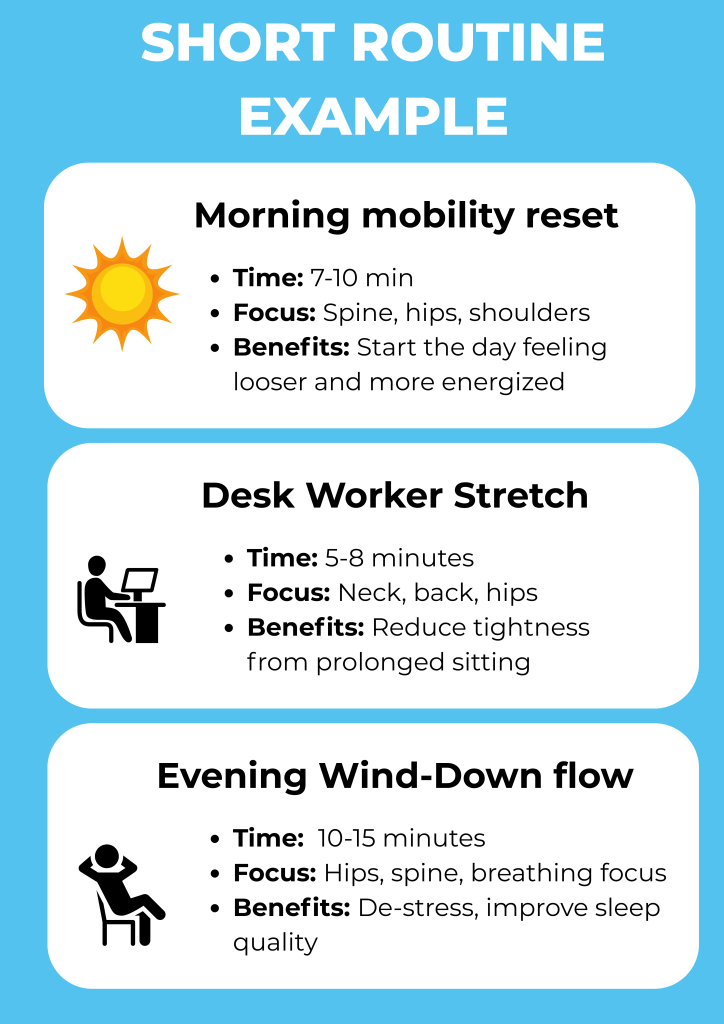
Short Routine Examples

What it is:
You engage your muscles to create and hold the stretch, with the band offering guidance, not assistance.

Why it’s useful:
  • Builds strength within the range of motion
  • Encourages control and stability
  • Improves joint health and performance


Teaching Tips for short routines:

  1. Goal based stretch routines
    You must always state the goal upfront, for example, “Today’s 10 minute routine is to reduce tightness from prolonged sitting at a desk”. This creates clarity and motivation
  2. Simplicity over Complexity
    Choose 3-5 simple movements (as shown in the videos) per routine. The goal for these daily routines is consistency and not complexity.
  3. ALWAYS include breath cues
    In short routines, breathing is your best friend, breath is your tool to maximise stretch benefit and relaxation. Use cues like: “Exhale deeper into the stretch” or “slow, steady breathing throughout”
  4. Educate on Benefits as you teach
    Briefly reinforce why they are doing it e.g. “This gentle resisted hamstring stretch helps maintain healthy hips and reduces lower back strain.”
  5. Adapt to energy levels
    For high-energy clients: more activation work and for tired participants: more passive acceleration.
  6. Use ‘feel good’ phrasing
    Especially for the general population, phrases like “relaxing tension,” “feeling lighter” or “reconnecting to your body” can increase adherence.
  7. Short does not mean Rushed
    Keep the pace a nice steady 5-10 minutes of mindful movements. This is always better than rushed 20 minute routines.
  8. Build Take-Home routines Always good to teach participants 2-3 ‘go to’ stretches for personal accountability, allowing them to develop their own 5-minute flows.